June 12 in business history: Silver in the canyon, an antitrust law signed, and a $44 million film that almost killed a studio

June 12 in business history: Silver in the canyon, an antitrust law signed, and a $44 million film that almost killed a studio

On June 12, three events separated by a century of business history converge: in 1859, two laborers digging a water pit in Nevada struck the Comstock Lode — the richest silver deposit in American history, which funded San Francisco's rise and minted Irish immigrant John Mackay into a man Jay Gould refused to fight; in 1934, FDR signed the Air Mail Act forcing the breakup of aviation giant UATC into three companies that became Boeing, RTX, and United Airlines, whose combined market cap today dwarfs what the empire was worth whole; and in 1963, Cleopatra premiered at the Rivoli Theatre after a production that ballooned from a $2 million budget to $44 million, nearly destroying 20th Century Fox, while exactly 18 years later on the same date, Raiders of the Lost Ark opened at $20 million and launched a $2.37 billion franchise.

On This Day in Business History
11/6/2026 · 20:37
3 suscripciones · 25 contenidos
Three events on June 12, separated by 105 years: two men digging a water pit in Nevada discovered the richest silver deposit in American history; a president's signature broke apart an aviation empire and accidentally created three of the world's largest aerospace companies; and a movie premiered in New York whose financial wreckage permanently reshaped Hollywood's relationship with budget discipline. Each event traces the same arc: a moment that looked like a catastrophe at the time, followed by consequences that took decades to fully register.

1859 — Two miners find silver by accident, and the West is never the same
On June 12, 1859, Peter O'Riley and Patrick McLaughlin were doing unglamorous work at the head of Six Mile Canyon in what is now western Nevada — digging a small pit to collect water for their gold-washing rockers. While sinking it, they hit a layer of rich black sand covering bluish-gray quartz. They kept digging. 1
A neighbor named Henry T. P. Comstock arrived shortly after, claimed the land was his for "grazing purposes," and muscled himself and his partner Manny Penrod into a share of the claim. It was the most effective gate-crash in American economic history. On June 27, 1859, an assay confirmed the bluish ore was three-fourths silver to one-fourth gold — worth more than $2,000 per ton in 1859 dollars. Silver mining in America had just been born. As mining historian Grant H. Smith wrote in 1943: "With the 'blue stuff' found in this trench, silver mining in America was born." 1
Comstock himself sold his share quickly for a pittance and died by suicide in 1870, never having understood what he possessed.
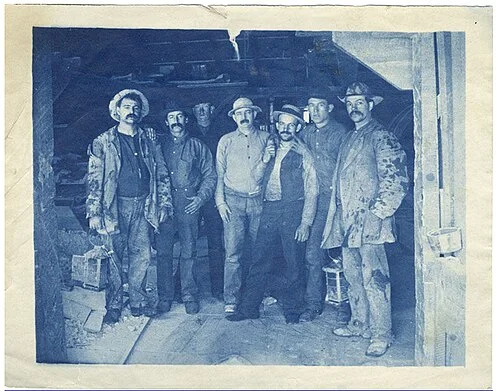
Comstock miners in the 1880s, posed at the mine entrance
1880s Comstock miners — "To Labor is to Pray" 1
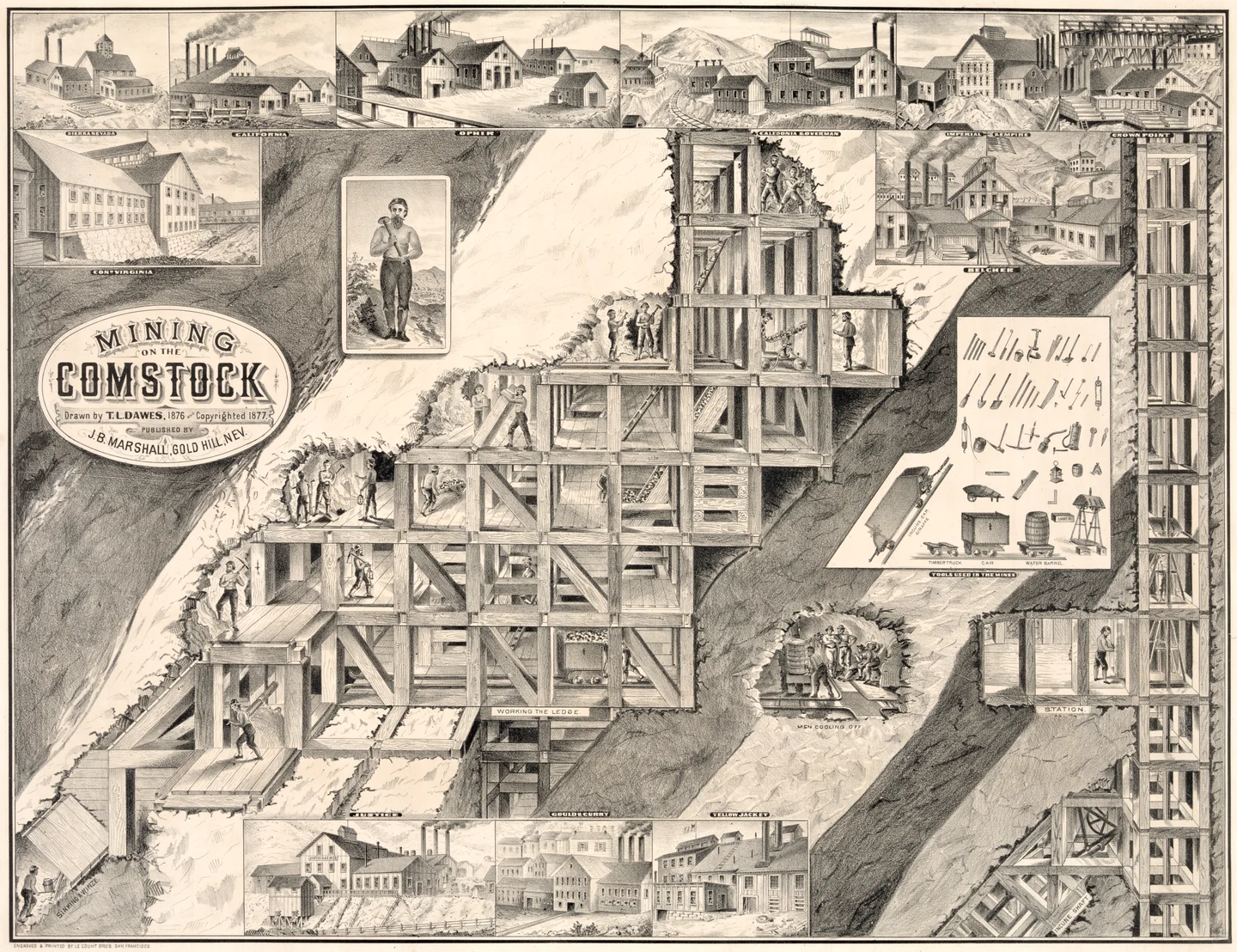
What followed was one of the most productive resource booms in recorded history. Official output from 1859 to 1882 reached $305,779,612 in gold and silver — and Nevada's State Historic Preservation Office cites estimates as high as $400 million. 2 Peak year was 1876: roughly $36 million extracted in twelve months. 3 Virginia City, which had not existed before June 1859, reached a population of more than 25,000 by the mid-1870s — the largest city between Denver and San Francisco — with an opera house, over a hundred saloons, a Chinatown of 1,500 to 2,000 residents, and a school that accommodated over a thousand students with indoor flush toilets. 3
The bonanza made a specific set of men extraordinarily rich. Four Irish immigrants — John Mackay, James Fair, James Flood, and William O'Brien, later called the Bonanza Kings — bought a cluster of small claims in 1871 for roughly $100,000. 4 In March 1873, at 1,200 feet below the surface, their Consolidated Virginia mine struck what became known as the Big Bonanza — an ore body 900 feet long and 200 feet wide. For three straight years afterward, the two mines produced $3 million per month. Total output over 22 years exceeded $150 million, with $78,148,800 paid out in dividends. 4 Mackay's personal share, by 2018 estimates, was worth roughly $50 billion in current dollars. 5
Jay Gould — the railroad and telegraph magnate who never lost a financial fight — eventually abandoned his efforts to financially pressure Mackay, explaining: "If he needs another million he will go into his silver mines and dig it out." 5
The money did not stay in Nevada. It flowed to San Francisco, where William Ralston had founded the Bank of California in 1864 and used the Comstock's capital flows to finance the Palace Hotel, coastal transport lines, insurance firms, and the speculation that eventually consumed him. 6 On August 26, 1875, rumors of failed mining investments triggered a run; by 2:35 PM the vaults were empty. Ralston resigned the next morning, signed over all his assets to his associate William Sharon, and drowned that afternoon in San Francisco Bay — whether accident or suicide was never settled. 6 7 The Comstock's capital funded Nob Hill mansions, the roots of Stanford University, and a stock exchange on Montgomery Street that contemporaries called the Wall Street of the West. Nevada, historian Gray Brechin wrote, was "San Francisco's most lucrative colony, a state commonly known as the nation's 'great rotten borough.'" 6
The innovations mattered as much as the money. German engineer Philip Deidesheimer invented square-set timbering at the Ophir Mine — interlocking cubic timber frames that allowed safe extraction of massive ore bodies and became the global standard for hard-rock mining. 1 Wire rope for hoisting, spring-loaded safety cages, and compressed-air drilling systems all developed on the Comstock or were refined there. Abraham Lincoln, who needed silver to finance the Civil War, accelerated Nevada's admission to statehood in October 1864 — before the territory had met the population threshold the Constitution required. 8
By 1878, the ore was thinning. Bodie, California had richer gold. Virginia City's population collapsed from 25,000 in the 1870s to 2,695 by the 1900 census. 3 Today 787 people live there, and it operates as a heritage tourism destination.
The mirror: The Comstock's pattern — a chance discovery, then a race between those who understood what they had and those who grabbed surface stakes before understanding arrived — recurs in every resource cycle, including the current one. The people who profited most were not the original discoverers (O'Riley and McLaughlin) or the namesake (Comstock) but the investors who arrived later with capital, technical expertise, and coordination (the Bonanza Kings). The bankers who routed the capital (Ralston) created institutions that outlasted the boom, then destroyed themselves through overextension into unrelated assets. The technological byproducts — timbering, wire rope, hoisting — outlasted the silver by a century.

1934 — FDR signs the Air Mail Act, and the biggest company in American aviation ceases to exist
On June 12, 1934, President Franklin D. Roosevelt signed the Air Mail Act of 1934 — also called the Black-McKellar Bill after its Senate sponsors Hugo Black of Alabama and Kenneth McKellar of Tennessee. 9 The law's core provision: no aircraft manufacturer could hold any interest in an airline, and no airline could participate in aircraft manufacturing. It was a structural prohibition aimed directly at one company.
That company was United Aircraft and Transport Corporation (UATC), assembled by William Boeing and Frederick Rentschler (president of Pratt & Whitney) in February 1929. 10 At its peak, UATC controlled Boeing Airplane Company, Northrop Aircraft, Stearman Aircraft, Pratt & Whitney, Chance Vought, Hamilton Standard propellers, Sikorsky Aviation, and five airlines that had been consolidated into United Air Lines. It built the aircraft, made the engines, manufactured the propellers, and flew the passengers. No other American aviation enterprise had been so thoroughly vertically integrated. 10 Its flagship product, the Boeing 247 — a twin-engine all-metal airliner that first flew in 1933 — could cross the United States in under 20 hours, faster than anything else in the sky. 11
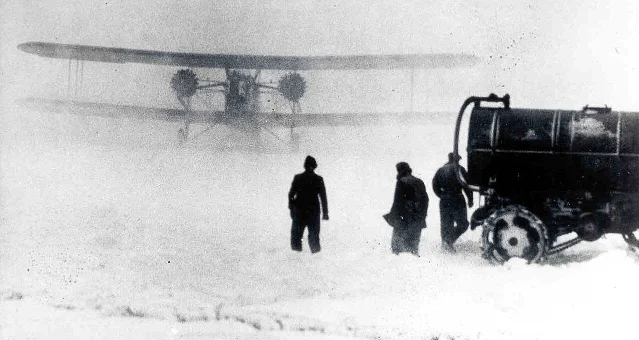
Keystone B-6 Army Air Corps mail plane in a snowstorm, 1934
Army Air Corps pilots flying outdated open-cockpit biplanes to carry mail in winter 1934 — 13 died in the weeks after Roosevelt canceled civilian contracts 12
The investigation that produced the law began in September 1933, when Senator Black's special committee seized the records of every air mail operator after finding that a series of lucrative mail contracts had been distributed in 1930 through a closed-door meeting — the "Spoils Conference" — that shut out smaller competitors. Roosevelt canceled all civilian air mail contracts in February 1934 and handed carriage to the Army Air Corps. Army pilots, flying open-cockpit biplanes designed for fair weather, had no winter navigation equipment. Thirteen died in crashes within weeks. 12 The public outrage accelerated the legislation rather than halting it.
The law that emerged forced UATC to split into three independent companies. The eastern manufacturing assets — Pratt & Whitney, Sikorsky, Chance Vought, Hamilton Standard — became United Aircraft Corporation, headquartered in Hartford, under Frederick Rentschler. The western manufacturing assets became Boeing Airplane Company in Seattle, under Claire Egtvedt. All airline operations became United Air Lines Transportation Company in Chicago. 10 13
William Boeing appeared before Black's committee and was subjected to what HistoryLink described as "a particularly withering examination." He found being called a monopolist intolerable. After the bill passed, he resigned as chairman, sold every share of Boeing stock he owned, and never played a significant role in the company or the industry again — save for a brief advisory appearance during World War II. 11 He collected the Daniel Guggenheim Medal for aviation leadership the same year, which was presumably cold comfort.
What happened next is the part that matters for the mirror. All three companies thrived — separately — in ways that a unified UATC almost certainly would not have.
Boeing, under Egtvedt's leadership, concentrated entirely on military aviation. The B-17 Flying Fortress first flew on July 28, 1935 — 14 months after the breakup. 14 Over 12,700 were built. The B-29 followed. Then the 707 entered commercial service in 1958, opening the jet age. The 747 flew in 1969 and created the modern mass-market long-haul model. Boeing merged with McDonnell Douglas in 1997 and recorded 2025 revenues of $89.5 billion. 14
United Aircraft Corporation renamed itself United Technologies Corporation in 1975, diversified through acquisitions into elevators (Otis), air conditioning (Carrier), and advanced aerospace components. In 2020, after spinning Otis and Carrier into independent public companies, it merged its aerospace and defense business — Pratt & Whitney engines and Collins Aerospace — with Raytheon Company to form RTX Corporation, one of the two largest aerospace and defense contractors on earth. 10
United Airlines survived a 2002 Chapter 11 bankruptcy filing — the largest in US airline history at the time — emerged from restructuring in 2006, and merged with Continental Airlines in October 2010 to briefly become the world's largest carrier. 10 It remains one of the US "Big Four."
The combined market capitalizations of Boeing (roughly $130 billion in 2024), RTX (roughly $150 billion), and United Airlines (roughly $30 billion) far exceeded anything a single UATC could plausibly have built. The 1934 forced breakup created more value than the empire it destroyed.
The mirror: The June 12 signing is a clean historical test case for a proposition that still surfaces in every antitrust debate: forced divestiture does not necessarily destroy value — it can redirect management attention, eliminate cross-subsidy inefficiency, and free each unit to pursue the strategy that fits its actual competitive environment. William Boeing did not believe this in 1934. The scoreboard 90 years later suggests he was wrong.

1963 — Cleopatra opens in New York. The budget was $44 million. The studio nearly died.
On June 12, 1963, Cleopatra had its world premiere at the Rivoli Theatre in New York City. About 10,000 people gathered outside. 15 Elizabeth Taylor and Richard Burton were not present — Taylor was in London, Burton was filming Becket. The film ran 244 minutes. Top ticket price was $5.50, a record for a single theatrical admission at the time. 15
What had produced those 244 minutes is a business history case study in scope creep, governance failure, and what happens when a single project is allowed to consume a corporation.
The film had been greenlit at $2 million for a 64-day shoot. The first production, at Pinewood Studios in England starting September 1960, spent $7 million over 16 weeks and produced 10 minutes of usable footage. Taylor contracted meningitis and then pneumonia requiring a tracheotomy. 15 Director Rouben Mamoulian resigned. Fox brought in Joseph L. Mankiewicz — paying $1.5 million through the studio's $3 million acquisition of his production company, Figaro Inc. — and moved the entire production to Rome. 15
In Rome, Mankiewicz shot without a completed script, writing pages at night while directing during the day, reportedly using amphetamine injections to maintain the pace. The production deployed 20,000 Italian extras for a single scene — Cleopatra's entry into Rome. Paper cups used on set cost $100,000. Bulgari designed jewelry for props visible on screen for seconds. 16 Author Patrick Humphries, writing Cleopatra and the Undoing of Hollywood in 2023, said he was "stunned by the profligacy of the production." 16
Production costs reached $31.1 million. Distribution, print, and advertising added $13 million. Total: $44 million (roughly $463 million in 2025 dollars), making it the most expensive film ever produced up to that point. 15 The initial budget had been $2 million. To fund the overruns, 20th Century Fox sold its 260-acre backlot in Los Angeles to Alcoa in 1961 for approximately $50 million. That land became Century City — at the time the largest privately funded urban development in American history. 17
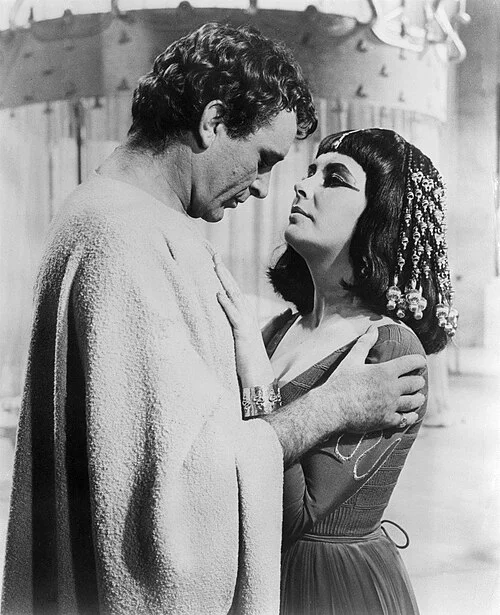
Elizabeth Taylor as Cleopatra and Richard Burton as Mark Antony — a film still from 1963
Taylor and Burton in the film — their real-life affair, condemned by the Vatican as "erotic vagrancy," generated publicity that made Cleopatra the highest-grossing film of 1963 15
The affair between Taylor and Burton — which began during filming and became a worldwide tabloid phenomenon that, according to contemporary accounts, at times displaced the trial of Adolf Eichmann from newspaper front pages — turned out to be the project's most effective marketing instrument. 15 Fox executives had feared the scandal would kill ticket sales. Instead, Cleopatra became the highest-grossing film of 1963 with $57.8 million in US and Canadian box office receipts. 15 It still lost money. By March 1966, worldwide rentals had reached $38.04 million — still $3 million short of the production and marketing cost. Fox finally broke even in 1966 by selling television broadcast rights to ABC for $5 million, then a record for a single film. 15
Fox chairman Darryl F. Zanuck had placed the blame on Mankiewicz in a press release distributed after the director completed his first cut: "In exchange for top compensation and a considerable expense account, Mr. Joseph Mankiewicz has for two years spent his time, talent, and $35,000,000 of 20th Century-Fox's shareholders' money to direct and complete the first cut of the film Cleopatra. He has earned a well-deserved rest." 15 Taylor, after watching the heavily cut general-release version at a London charity screening, had a different objection: "They had cut out the heart, the essence, the motivations, the very core, and tacked on all those battle scenes. It should have been about three large people, but it lacked reality and passion. I found it vulgar." 15
Fox survived because the next film its new management greenlit happened to be The Sound of Music (1965), which won five Academy Awards including Best Picture and generated enough revenue to stabilize the studio. 18 Then came Star Wars in 1977. Neither outcome was the result of strategic planning — they were recoveries from a near-death experience.
Exactly 18 years to the day after Cleopatra's premiere, on June 12, 1981, Paramount released Raiders of the Lost Ark. Budget: $20 million. Worldwide box office: $389.9 million. 19 It launched a franchise whose five films have grossed approximately $2.37 billion combined. 20 George Lucas — who had negotiated a deal giving Paramount no creative input in exchange for $20 million and retaining all licensing and sequel rights — kept the production to a self-imposed 73-day schedule specifically because Spielberg wanted to avoid the kind of overrun that had defined the previous decade. 19 The contrast is nearly cartoonish: $44 million and no profit vs. $20 million and a multi-billion-dollar franchise, both premiering at New York theaters on June 12.
The mirror: Cleopatra is the textbook case of what organizational psychologists call "scope creep with no circuit breaker" — a project where each individual cost overrun was defensible in context, but no governance structure existed to ask whether the cumulative position still made sense. Fox's mistake was not hiring Mankiewicz or casting Taylor; it was never establishing a hard ceiling at which someone with actual authority could have said "we stop here." Every production that began Raiders in the same era had watched Cleopatra's autopsy. The studios that survived the 1970s were the ones that had drawn conclusions from it.

Cover image: "Mining on the Comstock," engraving by T.L. Dawes, 1876, published by J.B. Marshall, Gold Hill, Nevada — public domain (Wikimedia Commons)

Añade más opiniones o contexto en torno a este contenido.

  • Inicia sesión para comentar.